Recreating the Bidford on Avon Cunning Woman
As living historians, we have the unique opportunity to delve deep into the ancient past, coming face to face with those who walked the footpaths and fields before us.
My fascination with the mysterious figure of the ‘Cunning Woman’ emerged from a desire to understand the power of the historic female healer and, like many of us, live out my very own witchy fantasy. Once you have dismissed all that you thought you knew and conquered the romantic dominance that Hollywood has over us, that is when you can start to appreciate the figure behind the folklore.
One ‘Cunning Woman’ in particular called to me, the 6th century grave HB2, also known as ‘The Bidford-on-Avon Cunning Woman’. Found in Warwickshire in 1971, her grave was at the edge of a pagan cemetery and contained a variety of unusual items that led historians to believe that she would have practised healing or ‘magic’. The esteemed archaeologist, Tania M. Dickinson studied the grave at length in the paper ‘An Anglo-Saxon ‘cunning woman’ from Bidford-on-Avon’ and concluded that the woman in grave HB2 could be considered a ‘Cunning Woman’ due to the possible amuletic purposes of some of the grave goods and the unusual knife found at her left side.
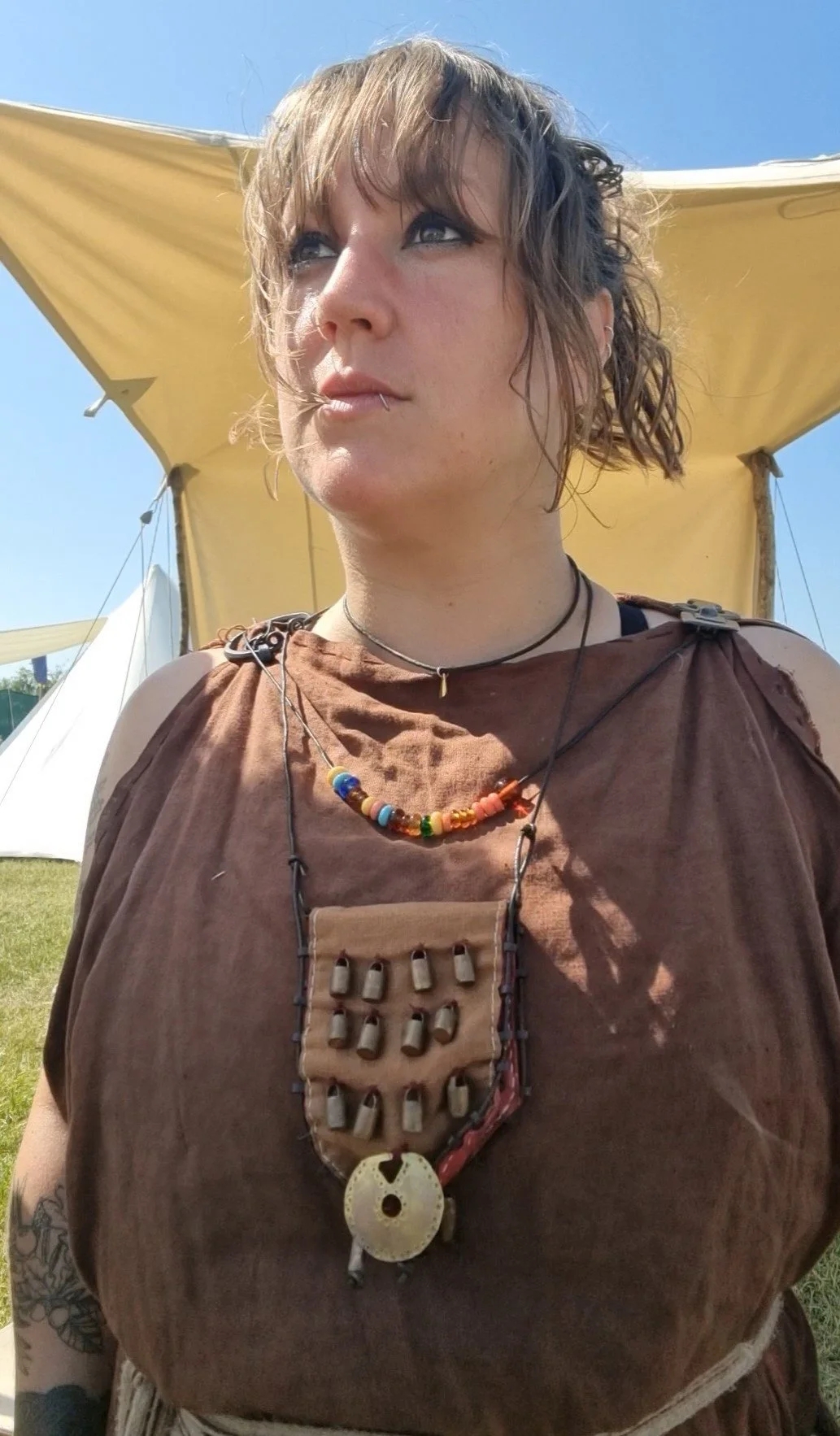
Through dedicated research and the faithful study of these grave goods, we have recreated these items to not only develop our own understanding of the uses and functions of these enigmatic objects, but to engage with the wider public using tangible pieces.
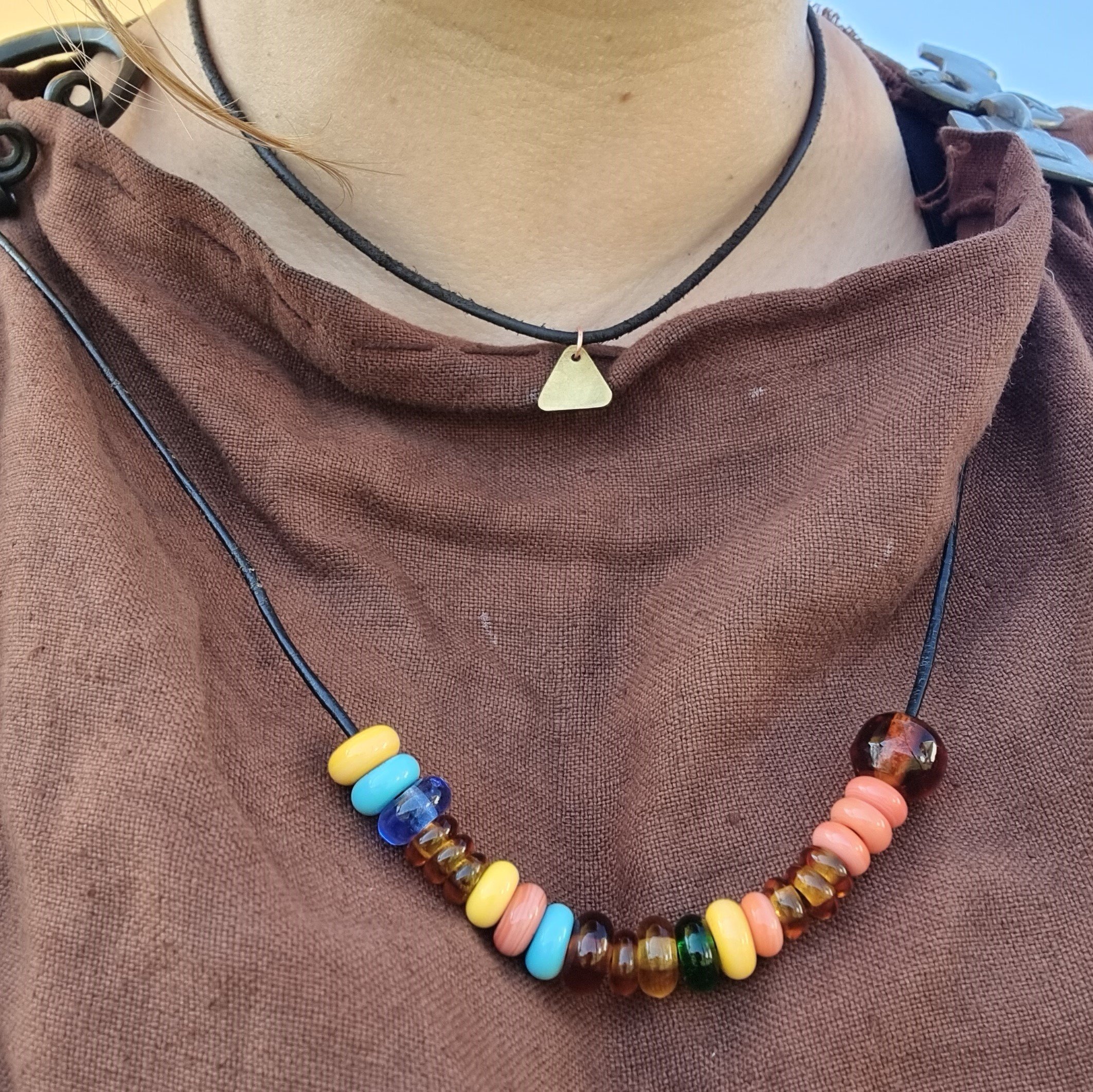
Alongside the two differing brooches at her shoulders, she was also found with a collection of glass and amber beads strung between them, and an iron cloak pin fastened what appeared to be a woollen cloak at her neck.
A bronze spangle was found at her jawline, possibly decoration for the cloak pin or included on her string of beads. I personally choose to wear the bronze spangle as a pendant on a necklace.
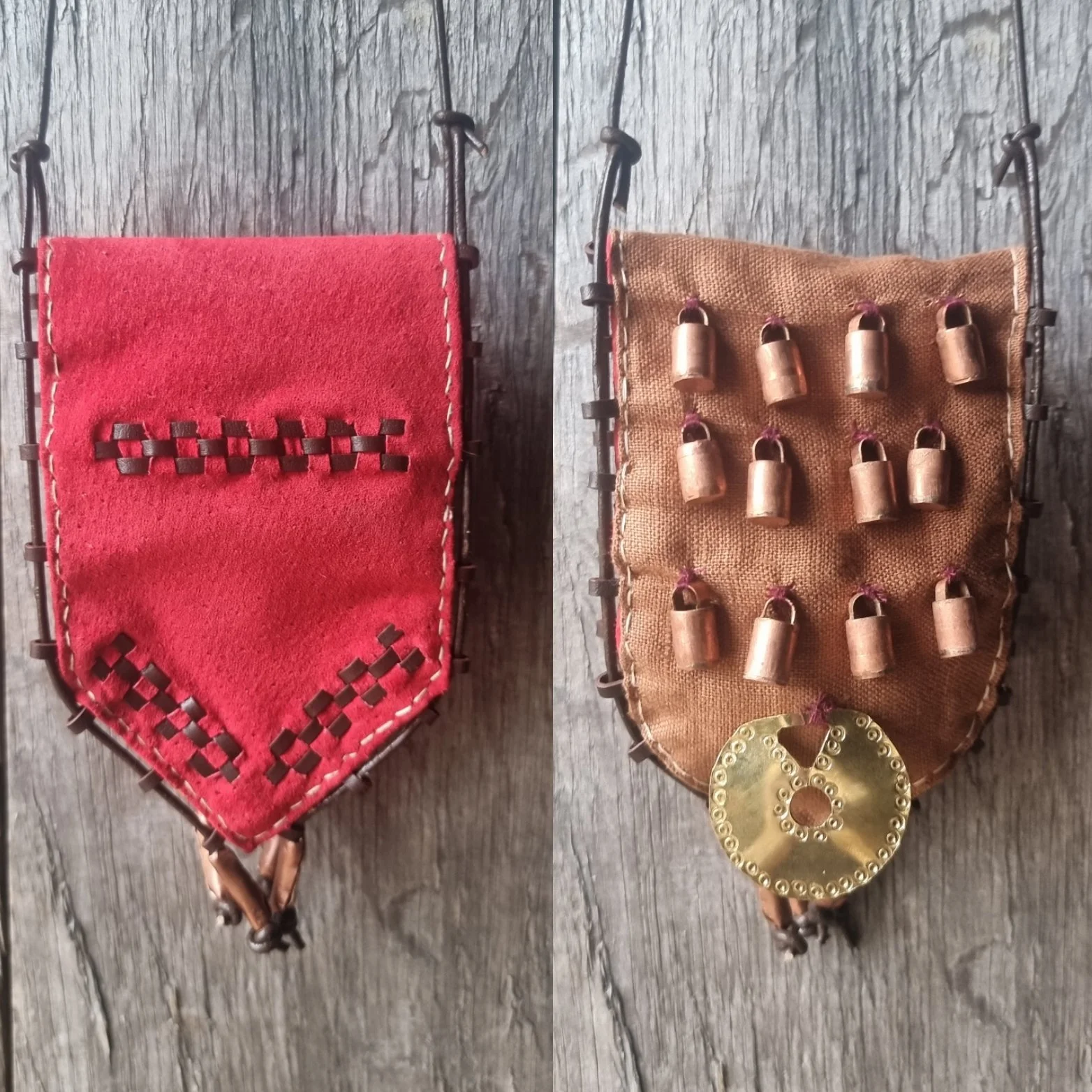
Under her left shoulder, archaeologists found twelve miniature bucket pendants, four small, bronze cylinders and a disc shaped pendant. Whilst these tiny bucket pendants are not unheard of in early Anglo-Saxon female burials, they are very rare. In other graves, it is possible the buckets would have been included as an element of costume jewellery and added to strings of beads.
However, HB2 is different. Found under the left shoulder blade in amongst the remains of leather and cloth, suggesting that these items were fixed to a bib that would have been worn around the neck. The design of our ‘bib’ is based on a that of the Viking Age Birka wallet.
Our ‘Cunning Woman’ also held a disc shaped pendent alongside her buckets. Could it have been a decoration from a full-sized Anglo-Saxon bucket perhaps? Or was it a familial item of note or sentimentality offering amuletic protection or good luck?
Lewis Beck, one of the talented craftspeople of Herigeas Hundas, was the creator of the buckets, amulet and the bib, also incorporating the four bronze cylinders as aglets.
My main question - what was the purpose of these buckets? Some contained the remains of spun animal-fibre thread, were these simple mementos or a way of storing materials? It is my belief that the buckets themselves and the contents were amuletic. My ongoing research into the role of the healer in Anglo-Saxon society has led me to study texts at length, like the 10th century medical tomes The Lacnunga, Bald’s Leechbook and the Old English Herbarium Manuscript V, as well and Roman, Greek and Egyptian medical records. There are charms and cures detailed that require liquid to be strained through cloth, are these preserved threads the remains of these scraps of fabric that the ‘Cunning Woman’ believed took on the healing properties of the charm?
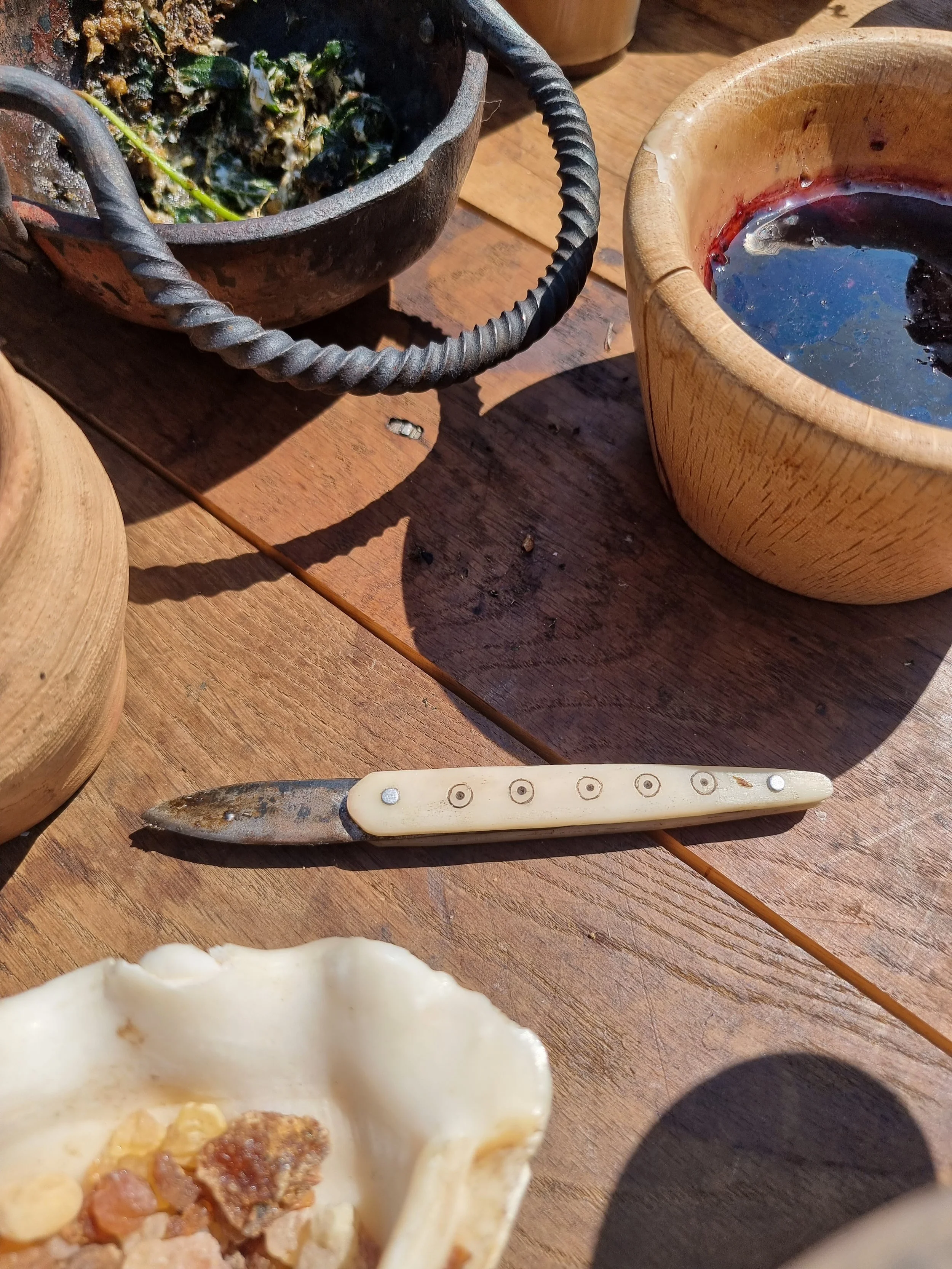
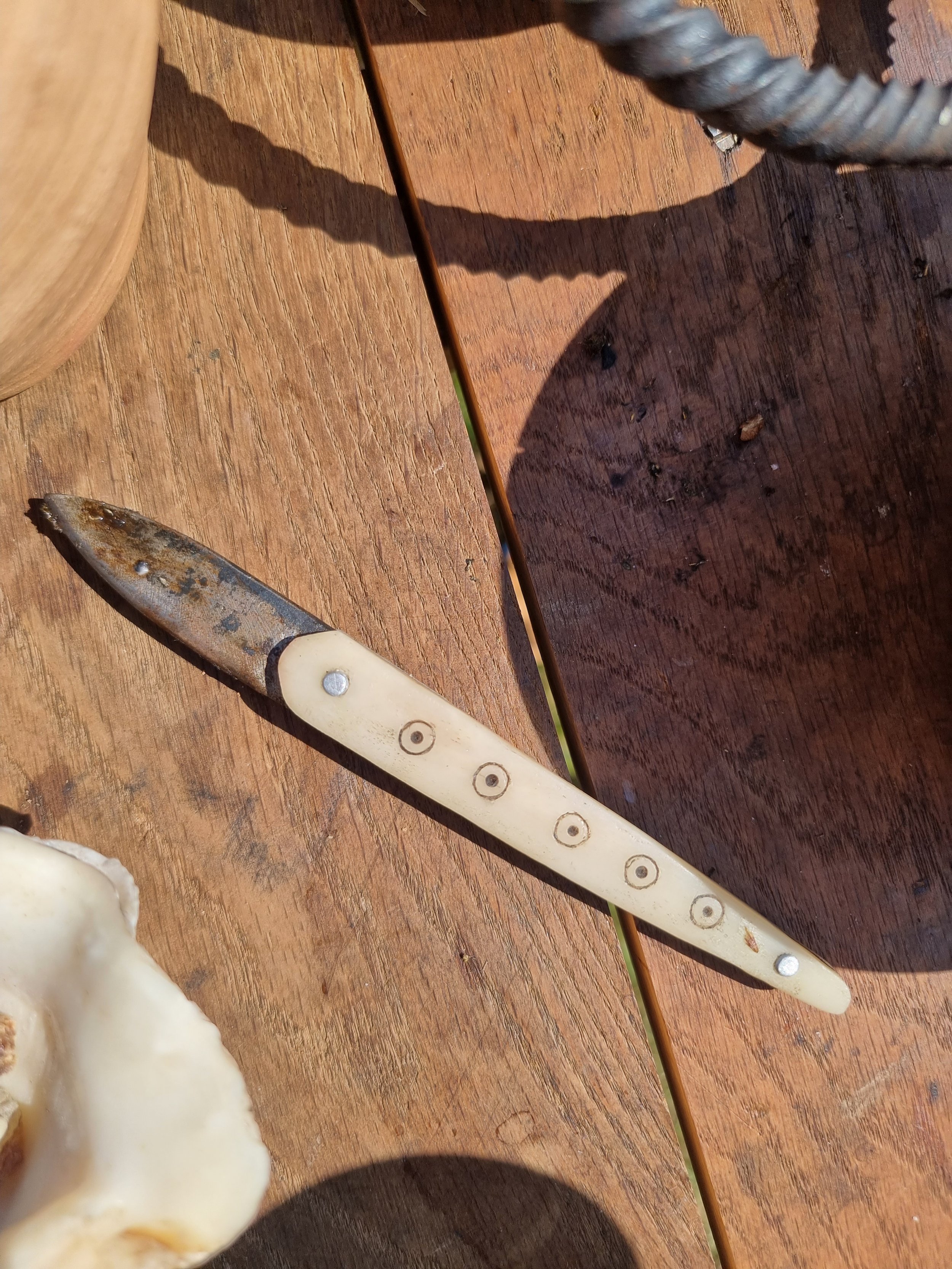
The knife found within the grave has a long handle from equine or bovine long bone and a short iron blade, it is clearly a knife of surgery and ritual and not the day to day seax of an Anglo-Saxon. The blade was recreated by Herigeas Hundas blacksmith, Joe Tyler and the handle by Lewis Beck. To handle this recreated blade, it simply screams scalpel, and an item that you can once again relate to the medical texts, which mention cures such as the careful cutting of the eyelid to apply a healing liquid.
An edited copy of this artcile featured in ‘Living Medieval’ magazine in July 2023 - https://heyzine.com/flip-book/d7e9273cc6.html#page/14
Dickson, T M. (1993) ‘An Anglo-Saxon ‘cunning woman’ from Bidford-on-Avon’, In Search of Cult: Archaeological Investigations in Honour of Philip Rahtz pp45 -54
Pollington, S (2000) Leechcraft: Early English Charms, Plantlore and Healing, Anglo Saxon Books
Windows on Warwickshire (2015), The Cunning Woman. Available at: https://www.search.windowsonwarwickshire.org.uk/Details.aspx?&ResourceID=11772&PageIndex=1&KeyWord=cunning%20woman&SortOrder=2 (Accessed 2017 onwards)